The 46% rise in global pre-school enrolment between 1999 and 2010 has generally not been matched with the equivalent rise in developmental outcomes for these children [1].This is largely due to the education being of insufficient quality. Broadly speaking, it has been argued that the various government efforts have focused too heavily on increasing pre-primary education capacity, without enough attention on ensuring adequate levels of quality education [1].
Here are photo examples of two schools in Pakistan. It demonstrates the variety of structural quality in the education buildings that are used within a country.

The one on the left is a public school, the children are sat on the floor, the teachers desk seems dusty and the educative resources that are available seem small print and complicated, not necessarily appropriate for the age group.
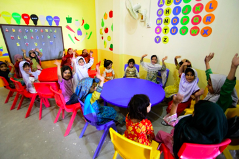
Conversely, this photo of a private pre-primary school has age specific furniture, bright colours, and the education resources on the wall are simple, and reflective of the children’s developmental age.
However, the structure that the children’s education takes place in alone, is not indicative of the quality of education they are receiving. In order to assess the quality of education, and give meaningful and appropriate feedback to programs on how to improve, criteria for what is considered to be of high quality needed to be devised. Britto, Yoshikawa and Boller [2] proposed 5 key dimensions of quality which shall be explored and used to analyse aspects of quality in various early learning programs in Pakistan. It is worth noting that the dimensions explored in this blog are one of a number of models for analysing quality. If you are interested in more models, here is another example [1].
1) Programs and policies align with the values and principles of a community or society
For a program to be high quality, it has to be embedded within the cultural context in which it is intended to serve, acknowledging aspects such as language, and attitudes towards pedagogy and the role of education and caregiving [2]

In Pakistan:
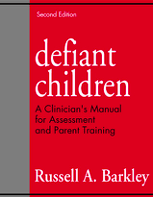
The training manual developed for American children, and adapted for use in Pakistani context [10].
Malik, Rooney, Chronis-Tuscano and Tariq investigated a behavioural based intervention for parent’s with children between 4 and 12 with ADHD in Pakistan [3] .The therapists made ongoing adaptations to the parenting model, that was originally designed for American parents but being implemented in Pakistan, to disseminate the cultural differences of approaches to childcare. For example, rates of attendance dropped once the therapist introduced token economy systems to behaviour management. Once the therapist’s realised the parent’s struggled to understand the concept, they adjusted the intervention to spend more time delivering additional support to contextualise the token system in ways that made sense in the culture of Pakistan [3].
2) Resource levels and their distribution
This includes human and physical resources, for example the levels of teacher training, cash incentives, as well as availability of print materials, clean water, and nutrition [2].
In Pakistan:
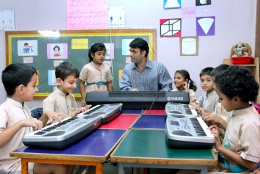
The Aga Khan Development Network [4] in Pakistan specialises in training pre-primary teachers. This program addresses resource levels by providing opportunities in rural Pakistan for advanced level teacher training. It also addresses the fifth quality dimension outlined below, as it focuses on student-centred learning by fostering independent thinking and problem-solving skills in children rather than memorising through rote learning.
3) Physical and spatial characteristics
This concerns not only the aesthetic quality of the structures and spaces that are used, as outlined at the beginning of this blog, but aspects of safety from harm caused by environmental factors such as flooding, heat exposure, or sanctuary from dangerous animals. This also includes the levels of basic needs such as access to clean water and toilets [2].
In Pakistan:
It is estimated that 4.5 million children are in the public sector katchi-class, meaning ‘not mature’, or of pre-primary ages between 2 and 4 years old. Most government funded schools in Pakistan do not have separate classrooms for katchi classes, or specifically trained teachers [5] [6]. One way to mitigate this issue can be analysed using the quality dimensions, specifically 1, 2 and 4. Sipahimalani-Rao and LaRocque [6] argue that the government should expand the concept of early childhood education beyond the current katchi-class age ranges, to encompass up to 8 year olds. This would become the globally recognised age range for early childhood interventions. This addresses dimension one, as it integrates the current community context of age range classification with global standards. Dimension two as it would alleviate the need to hire separate teachers, instead training one teacher in childhood pedagogy that is appropriate to the full age range. Dimension 4 because it would remove the current requirement of separate classrooms and facilities.
4) Leadership and management
This identifies the critical role of how the way in which programs are led affect the quality of the education delivered. This encompasses small scale responsiveness to problem solving issues such as teacher sickness, through to national government level decision making in areas such as funding allocation, monitoring of outcomes and collaboration across ministries and charitable organisations [2].
In Pakistan:
Although the government has created and reviewed a curriculum specifically for early learning years, it has largely not been implemented [5] [6]. Changes to education policy address the current issues of quality in early childhood education [7], yet decision making processes at the government level are embroiled with party politics, bureaucracy and relationship conflict, which hinder effective implementation [8].
5) Interactions and communications
Interactions and communications encompass multiple levels. At the micro level it identifies how the teachers and facilitators interact with children and parents whom are in receipt of the program. At the macro level, this dimension identifies how programs communicate and engage the wider communities, especially towards minority or marginalised groups, and those for whom early childhood programs are not their cultural norms [2].
In Pakistan
Changes teacher training curriculum has attempted to move away from teacher-as-dictator, towards teacher-as-facilitator [8]. Hunzai has noted that it is common in Pakistan for the profession of early years teaching to be viewed as a last resort, not requiring special expertise and knowledge [8]. This represents the multiple levels in which communication and interaction is an important factor in the quality of education. On the micro level, to improve children’s outcomes, teachers should be trained in child lead techniques such as positive appraisal and encouragement, rather than corporal punishment. In a macro level, early childhood programs has the opportunity to communicate and interact with communities in redressing the views of the job role as being a skilled and worthwhile profession.
This blog has explored examples of early childhood programming in Pakistan, as well as the policy level contexts in which those interventions sit. Britto, Yoshikawa and Boller’s five dimensionshas been adopted as a lens in which to access quality, and identify areas that require improvement to improve pre-primary intervention outcomes [2]. If you have any questions, please write a comment below!
References
[1] UNICEF. (2017). Overview: MELQO: Measuring early learning quality and outcomes. UNESCO Publishing. Retrieved from https://books.google.co.uk/books?hl=en&lr=&id=S50zDwAAQBAJ&oi=fnd&pg=PA3&dq=MELQO&ots=6ZlRE5WZF4&sig=OuvJmM3pq3fOcjmO0dIr-zSYq20&redir_esc=y#v=onepage&q=MELQO&f=false
[2] Britto, P. R., Yoshikawa, H., & Boller, K. (2011). Quality of Early Childhood Development Programs in Global Contexts: Rationale for Investment, Conceptual Framework and Implications for Equity and commentaries. Social Policy Report, 25(2), 1-31.https://srcd.onlinelibrary.wiley.com/doi/pdf/10.1002/j.2379-3988.2011.tb00067.x
[3] Malik, T. A., Rooney, M., Chronis-Tuscano, A., & Tariq, N. (2017). Preliminary efficacy of a behavioral parent training program for children with ADHD in Pakistan. Journal of attention disorders, 21(5), 390-404. https://doi.org/10.1177/1087054714524158
[4] The Aga Khan University. n.d. Institutes for Education Development. Retrieved from: https://www.akdn.org/our-agencies/aga-khan-university/institutes-education-development-ied
[5] Khan, M. A. (2018). The status of early childhood education in Pakistan: Inside stories. Contemporary Issues in Early Childhood, 19(3), 310-317. https://doi.org/10.1177/1463949118757049
[6] Sipahimalani-Rao, V., LaRocque, N. 2019. School Education in Pakistan: A Sector Assessment. Asian Development Bank. Retrieved from http://dx.doi.org/10.22617/TCS190039
[7] Arshad, M., & Zamir, S. (2018). Situational Analysis of Early Childhood Education in Pakistan: Challenges and Solutions. Journal of Early Childhood Care and Education, 2, 135-149. http://jecce.aiou.edu.pk/wp-content/uploads/2019/01/10-Situational-Analysisi-of-Early.pdf
[8] Hunzai, Z. N. (2009). Teacher education in Pakistan: Analysis of planning issues in early childhood education. Journal of Early Childhood Teacher Education, 30(3), 285-297. https://doi.org/10.1080/10901020903084421
[9] Aga Khan Development Network. (n.d) Retrieved from https://www.akdn.org/where-we-work/south-asia/pakistan/education-pakistan
[10] Barkley, R. A. (2013). Defiant children: A clinician’s manual for assessment and parent training. Guilford press. Retrieved from: https://www.goodreads.com/book/show/926791.Defiant_Children
[11] Rahim, Bushra. 2014. Pakistan: Children in primary schools should be taught in their mother tongue. Retrieved from: https://gemreportunesco.wordpress.com/2014/10/16/pakistan-children-in-primary-schools-should-be-taught-in-their-mother-tongue/
 Ben Ford Global Early Childhood
Ben- I really enjoyed reading your blog. I thought that the continuation of your theme from Blog 1 was really clever. The introduction is really engaging and immediately justifies the importance of this topic. I like that you also explained the reasoning behind this, to provide a really comprehensive explanation of why you have chosen this topic. I like the way you have made references to the picture in your blog, instead of including pictures just to break up the text. This makes the use of pictures really purposeful and interesting, and reinforces the points you are making. The fact that you have included both structural and procedural aspects of quality provides a really comprehensive reading experience. It allows the reader to gain understanding in the number of interacting factors impacting early child education experiences. The section on how to measure the quality of early childhood education programmes was really helpful in providing clarity of what your blog will discuss. The inclusion of other methods of analysing quality was a really effective way of acknowledging that this is only one perspective. You then used this framework as a template for your blog, which enhanced the flow of your blog. I thought that the cultural adaptations made to the intervention was really interesting, and clearly a crucial aspect of early childhood education programmes. I also liked the way you applied this framework to your region consistently throughout the blog. The issues you raised were specific to your region, and you used figures to reinforce this point. The use of reference links is really helpful and effective for the reader. Finally, the layout is really professional and orderly. Good job! Optimise Wellbeing x
LikeLike
Hi Ben, I liked how your started off your blog post with a statistic that showed that the global pre-school enrolment was not being met due to being insufficient quality. This just shows how important quality is with regards to conduction an early childhood education programme. I also liked that you provided photo examples of two different schools in Pakistan to show the differences between public and private schools in Pakistan. In your following points, I liked how each different sections are labelled clearly and how each key dimensions of quality is related back to your chosen context of Pakistan. It is great how you provided what is being done in Pakistan to increase the quality of early childhood education. I also agree with the points you made regarding the key dimensions, as quality programmes need to be in line with the values and principles of a community, so that they can be easily accepted by the target population. With regards to resource levels and their distribution, in LMIC it is often difficult to attain, however any effort being put into providing resources is better than none. Leadership and management is also another great point to discuss when it comes to the quality of programmes as I find having a programme that is led well will lead to better outcomes for the target population. Finally, communication is also a great quality to have when implementing these programmes as it is important to spread the message as effectively as possible through all communication channels. Overall, it was a really enjoyable read and everything was clearly stated and labelled and good use of images as well, it definitely gave me a better picture of the situation in Pakistan.
Anugerah
LikeLike